
Posted by Steve on Aug 5th 2026
The Four Rules of Gun Safety — and What They Look Like in Northern Nevada
Firearm safety · Yerington, Nevada
There are four rules. They fit on an index card, they have not meaningfully changed in fifty years, and almost nobody who has ever had a firearms accident was breaking only one of them.
That last part is the entire point. The four rules are deliberately redundant. Each one is a backstop for the other three, so that a single mistake — and everybody makes one eventually — stays a mistake instead of becoming a tragedy. Here is how we teach them at the counter, with the parts that matter most out here in the high desert.
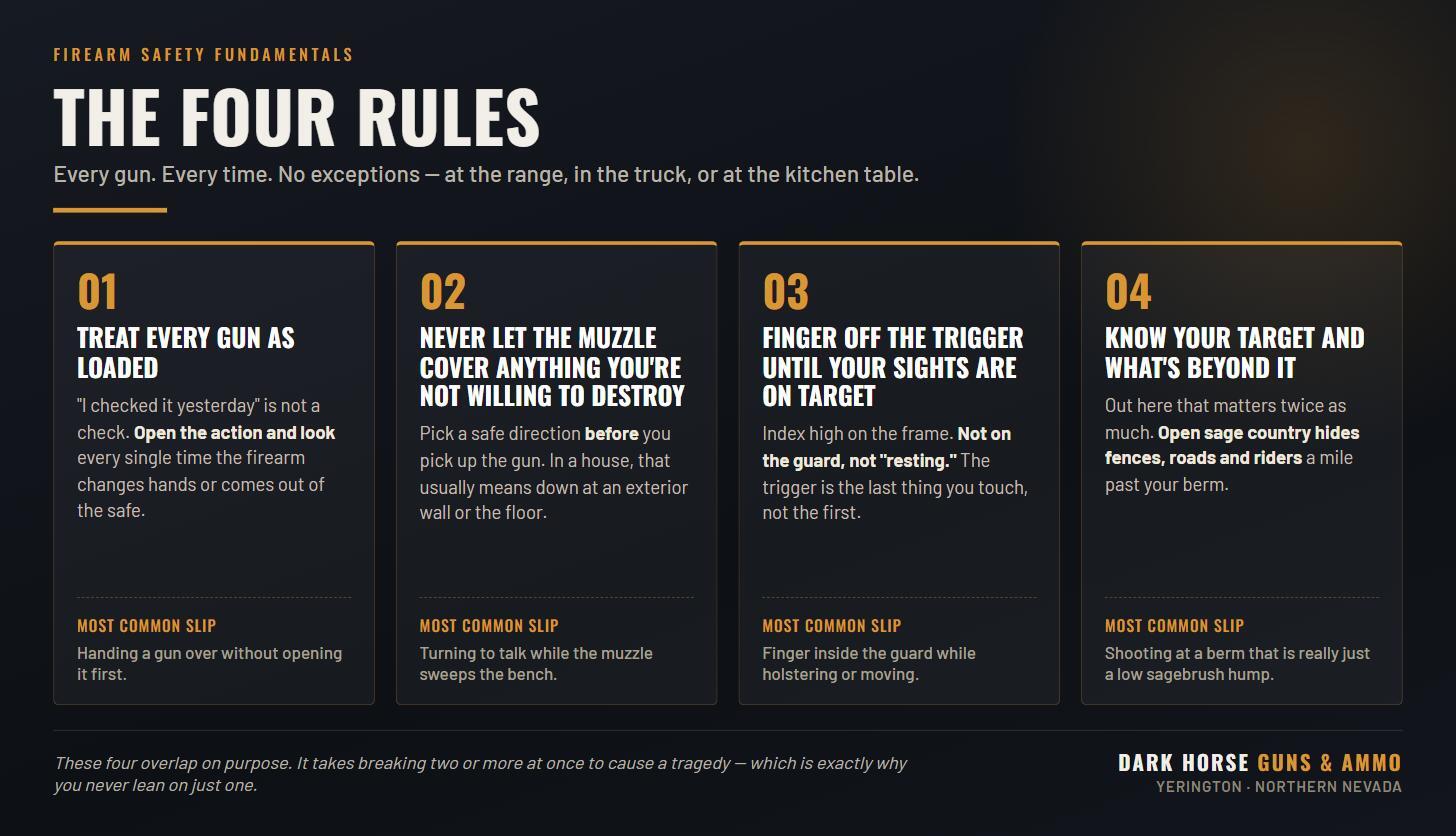
Rule 1: Treat every firearm as if it is loaded
Not "assume it might be." Treat it that way, which is a behavior, not a belief. The habit that makes this real is simple: every single time a firearm comes into your hands — out of the safe, out of the case, handed across a tailgate, picked up off a bench — you open the action and look. Look, and put a finger in there if the light is bad.
"I checked it ten minutes ago" is how people get hurt. The person who unloaded it and the person holding it now are not always the same person, and sometimes they are and it still went sideways.
The corollary: when you hand a firearm to someone, open the action first and keep it open. When someone hands you one, check it yourself even though you just watched them check it. Nobody in this valley will take offense. If they do, that tells you something too.
Rule 2: Never let the muzzle cover anything you are not willing to destroy
Muzzle discipline is the rule people break most and notice least, because it gets broken during the boring parts — turning to answer a question, setting a rifle in a rack, carrying a pistol from the bench back to the truck.
Pick your safe direction before you pick the gun up. At the range that is downrange, every time. In a house it is usually the floor or a ground-level exterior wall with dirt behind it, not the interior wall your kid's headboard sits against. In a vehicle it is out and down.
Spend five minutes walking your own house thinking about this. Where does a round go if it leaves the muzzle in the room where you load, unload and clean? If you cannot answer that, you do not have a safe direction yet. You have a hope.
Rule 3: Keep your finger off the trigger until your sights are on the target
Index high — on the frame or receiver, above the trigger guard, where you can feel it with the pad of your finger. Not resting on the guard, which is one startle reflex away from being inside it.
Two moments account for most negligent discharges: holstering, and clearing a malfunction. Both involve movement, both put a hand near the trigger, and both tend to happen when you are a little rushed or a little embarrassed. Slow both of them down on purpose. If you carry, dry practice your draw and holster until it is boring — eyes on the holster, slow, thumb riding the hammer or the back of the slide.
Rule 4: Know your target and what is beyond it
This is the rule Northern Nevada changes.
Open sage country plays tricks on distance. A "berm" that looks solid at a hundred yards is frequently a two-foot rise with a mile of flat behind it. A rifle bullet that clears that rise does not stop at the horizon. Common centerfire cartridges can carry a couple of miles with enough elevation, and even .22 LR stays dangerous far past where most people imagine.
Before the first shot, actually look past the target. Out here that means scanning for ranch two-tracks and BLM roads, irrigation canals and ditch banks, cattle and wild horses, hunters or side-by-sides in the next draw, powerlines, stock tanks, and houses that are farther out than you would guess but are still there. Glass it if you brought binoculars.
Then pick a real backstop: a dirt cut, a rock face, a bank taller than your line of fire. Angle matters as much as distance. Shooting slightly downhill into a genuine cut bank is safe. Shooting level across a flat is not, no matter how empty that flat looks.
Where people actually get hurt
Almost never while shooting. Nearly always during the administrative handling that happens around the shooting:
- Loading and unloading — the magazine comes out but the chamber does not get checked. Order matters: magazine first, then the chamber, then look, then look again.
- Cleaning — the old classic. The gun was "unloaded." Make it a hard house rule that no ammunition is in the room where you clean, ever.
- Showing a gun to someone — excitement plus a small room plus a loaded chamber. Clear it before it leaves the case.
- Holstering — especially with soft holsters, drawstrings, or a cover garment that folds into the trigger guard.
The Northern Nevada wrinkles
- Dust and grit. Our air is dry and the ground is fine powder half the year. Grit in the action causes the malfunctions that cause the panicked, unsafe fixes. Wipe down and re-lube lightly after every trip; heavy oil out here is a dust magnet.
- Cold hands and gloves. Trigger feel in January is not trigger feel in July. If you shoot in gloves, practice in gloves.
- Sun, wind and grit in the eyes. Wraparound eye protection, not just for ricochet but for the wind. Squinting into blowing dust is how people lose track of their muzzle.
- Distance from help. A lot of the best spots have no cell service. Keep a trauma kit with a tourniquet and a pressure bandage in the rig, know how to use it, and tell somebody where you are going and when you will be back.
- Hearing. Plugs and muffs together for rifles and braked guns. Sound bounces hard off cut banks and rock walls, and the damage does not announce itself.
A habit stack you can run in five seconds
- Muzzle in the safe direction before hands change.
- Open the action and look. Every time, no exceptions.
- Finger indexed high until the sights are on target.
- Look past the target before the first shot.
- Unload deliberately at the end of the day: magazine, chamber, look, look again.
Do that long enough and it stops being a checklist and starts being how your hands work. That is the goal. Rules you have to remember are rules you will eventually forget.
Come by the shop
518 W Goldfield Ave, Yerington. Open Tuesday through Saturday, 10 to 5. Whether you bought it from us or not, bring your firearm in and we will walk you through loading, unloading and safe storage for that specific gun. No charge, no sales pitch. New shooters especially welcome.
Get in touchDark Horse Guns & Ammo LLC is a federally licensed dealer in Yerington, Nevada. This article is general safety information, not legal advice and not a substitute for hands-on instruction from a qualified trainer. Firearm sales and transfers are subject to all applicable federal and Nevada law.