Posted by Steve on Aug 5th 2026
Shooting on Public Land in Northern Nevada: Rules, Fire Season, and Leaving It Better
Public land · Yerington, Nevada
Nevada is about eighty percent federally managed land. That is the single best thing about shooting here and the single easiest thing to lose. Dispersed target shooting on BLM ground is generally allowed, it is generally free, and it is generally within a twenty-minute drive of wherever you are standing. It stays that way only as long as shooters do not give the agencies a reason to close it.
Here is the practical version of what to know before you drive out past the pavement.
Know whose dirt you are standing on
Out here BLM, Forest Service, state land, tribal land and private ranch ground sit right next to each other, often with nothing but a wire fence and a faded sign to tell you which is which. The rules are not the same on each, and "there was no sign" is not much of a defense.
Before you go, check the boundaries on a mapping app that shows land ownership, or call the BLM field office that covers where you are headed. If you are anywhere near a fence line, a corral, a water tank or a two-track that clearly gets used, assume somebody works that ground and act accordingly.
Picking a spot
The single most important thing is the backstop. Everything else is secondary.
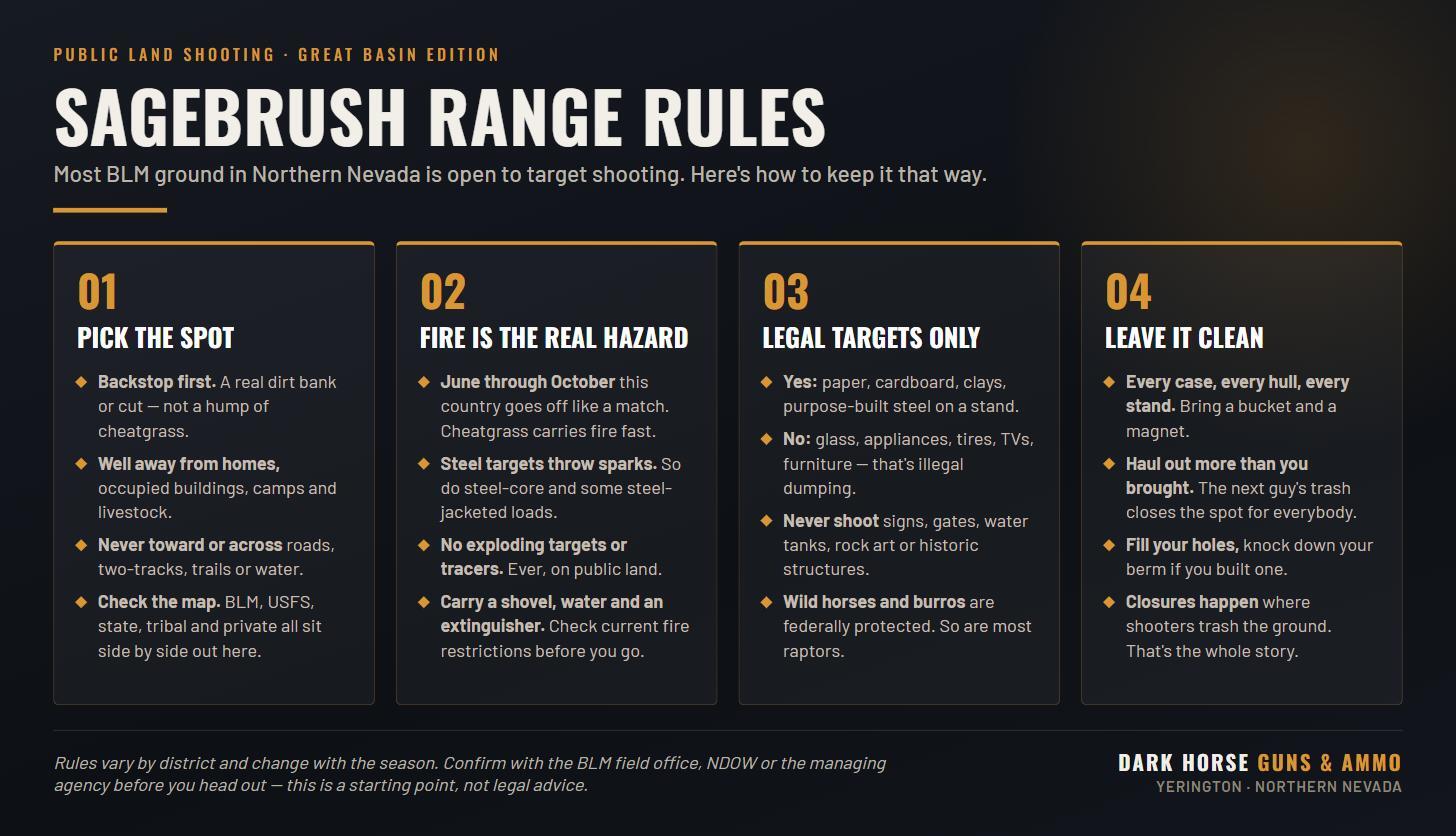
- Shoot into a real bank. A dirt cut, a gravel pit wall, a hillside. Not a sagebrush hump, not a berm of loose sand two feet tall, not "the ground over there."
- Stay well away from occupied buildings, camps, livestock, and anything that looks like somebody's home. Federal and state rules set specific distances, and they are longer than most people assume. When in doubt, move.
- Never shoot toward or across a road, two-track, trail, canal or body of water. Water and hard-packed roads skip bullets in ways that surprise people.
- Look uphill and downhill. Riders, hikers, hunters and side-by-sides show up in draws you cannot see from where you parked. Walk the ground behind your target before you start.
- Do not set up where the only way for someone to reach you is to walk through your line of fire.
Fire is the real hazard out here
From roughly June into October, this country is fuel. Cheatgrass cures out to tinder by early summer and carries fire faster than you can walk. A shooting-caused range fire is a genuinely life-changing event: people have been billed for suppression costs, and closures have followed.
- Check current fire restrictions before every trip. They change through the season and they differ by district.
- Steel targets throw sparks. So do steel-core and steel-jacketed bullets hitting rock. In dry season, paper and cardboard against a dirt bank is the low-risk choice.
- Exploding targets and tracers are off the table. Not "risky." Prohibited on public land, and the source of some of the West's worst human-caused fires.
- Carry the kit: a shovel, a fire extinguisher, and several gallons of water. Park on bare dirt, not in tall grass — a hot catalytic converter starts as many fires as bullets do.
- If something smokes, put it out and call it in. A five-foot fire is a story you tell later. A five-acre fire is not.
What you can and cannot shoot at
Legal targets are the ones you brought and will haul out: paper, cardboard, clay birds, and purpose-built steel on a proper stand.
Not legal, and not okay: glass bottles, TVs, appliances, tires, furniture, propane bottles, and the couch somebody dragged out there last spring. Shooting trash is illegal dumping with extra steps, and the broken glass stays for decades.
Also permanently off limits: signs, gates, cattle guards, water tanks and troughs, powerline insulators, rock art and historic structures. Nevada has an enormous amount of archaeology sitting out in the open, and a bullet through a petroglyph panel is a federal problem. Wild horses and burros are federally protected, as are most raptors and a long list of other species. If it is alive and you are not hunting it in season with the right tag, leave it alone.
Pack it out. All of it.
This is the part that decides whether the spot you like is still open in five years. Agencies close dispersed shooting areas because of trash and damage, not because of noise.
- Bring a bucket for brass and a cheap magnet on a stick for steel case. It takes ten minutes.
- Take every target, stand, staple and shotgun hull you brought, plus a grocery bag of whatever the last guy left.
- Fill in the holes you dug and knock down anything you built.
- Do not leave clay boxes, ammo boxes or bottles weighted down with a rock. The wind here will find them.
Desert practicalities
- Cell service is a coin flip. Tell somebody your plan and your return time. Download your maps before you leave pavement.
- Carry more water than you think you need, and a trauma kit with a tourniquet. The nearest hospital is a long way from most of these spots.
- Watch the road, not just the target. Playa mud after a storm, washouts, and sharp rock are the top three reasons people walk out.
- Wind and mirage. Afternoon wind in the Great Basin is not a suggestion. If you are working at distance, morning is your friend.
- Rattlesnakes are around from spring through early fall. Watch where you set your bag down and where you reach.
When a real range makes more sense
Public land is great for informal plinking and load workups. It is a poor place to learn. If you are brand new, if you are working on your draw, or if you just want a bench and a berm somebody else built, drive to an established range and let a range officer keep you honest. Ask us at the counter and we will point you toward what is currently open in the region — hours and membership rules change often enough that we would rather tell you in person than print it here.
Come by the shop
518 W Goldfield Ave, Yerington. Open Tuesday through Saturday, 10 to 5. We can talk through where people are shooting right now, what the fire restrictions look like, and what ammunition makes sense for the season.
Get in touchDark Horse Guns & Ammo LLC is a federally licensed dealer in Yerington, Nevada. This article is general information, not legal advice. Rules for target shooting vary by land management agency, district and season, and they change — confirm current restrictions with the BLM field office, the U.S. Forest Service, NDOW or the managing agency before you head out.