

Posted by Steve on Aug 5th 2026
Waterfowl Hunting at Mason Valley WMA (MVWA): Hunt Days, Shot Rules and Licensing
Waterfowl · Yerington, Nevada
Mason Valley Wildlife Management Area — MVWA to most people around here, MVWMA in NDOW's own write-ups — sits on the Walker River just outside Yerington. It covers 17,742 acres, roughly 75 miles southeast of Reno, and for anybody living in Lyon County it is the closest serious waterfowl water there is. Ten minutes from the shop.
NDOW describes the area as everything from desert shrub land to wet meadow. The Walker River floodplain meanders through it providing food, cover and water, and wet meadows and ponds are scattered across the property pulling in ducks, geese, swan, songbirds and wading birds. The deeper water of the newer North Pond reservoir holds fish, osprey and pelicans, and the alkali desert scrub upland shelters mule deer and raccoon. It is a genuinely good piece of ground.
It is also a managed wildlife area rather than open desert, which means it carries its own rules on top of the state and federal ones. One of those rules catches more first-time MVWA hunters than everything else combined, so we are putting it first.
MVWA is not open every day during waterfowl season
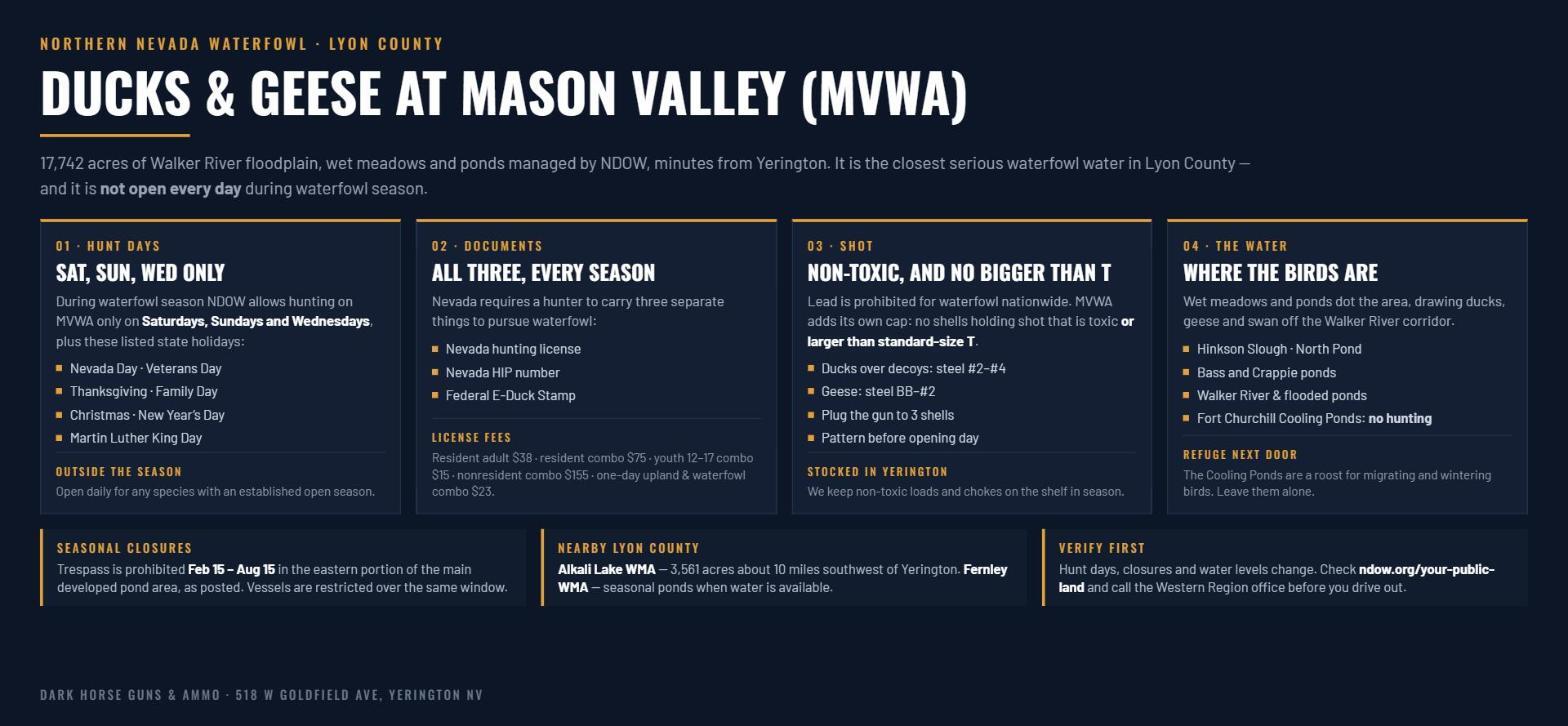
This is the one to write on your hand. Under NDOW's rules for the area, during the waterfowl season hunting on Mason Valley is permitted only on Saturdays, Sundays and Wednesdays, plus a specific list of legal state holidays:
- Nevada Day
- Veterans Day
- Thanksgiving
- Family Day, the day after Thanksgiving
- Christmas
- New Year's Day
- Martin Luther King Day
Before or after the waterfowl season, the area is open every day for any species that has an established open season. So a Tuesday in September is not the same thing as a Tuesday in December. Check the calendar before you burn a morning and a tank of fuel.
Three documents. All three. Every season.
NDOW is unusually specific about this one, so we will be too. To pursue waterfowl in Nevada, a hunter needs:
- A Nevada hunting license. Resident adult is $38, resident adult combination hunting and fishing is $75, youth combination for 12 to 17 is $15, and a nonresident adult combination is $155. There is also a one-day combination permit to fish and hunt upland game and waterfowl listed at $23 for adults, which is a genuinely good option for an out-of-town friend. Fees are set by the Legislature under NRS 502.240.
- A Nevada HIP number. The Harvest Information Program registration. It is quick, and it has to be done each season.
- A Federal E-Duck Stamp. The federal migratory bird stamp. You can buy it through the state licensing system or directly from the U.S. Fish and Wildlife Service.
License, HIP and E-Duck Stamp are all available through NDOW's licenses, tags and permits page, linked below. A hunting license by itself covers upland game and waterfowl in Nevada, so there is no separate tag for ducks and geese the way there is for big game, but the HIP number and the federal stamp are not optional.
What counts as waterfowl in Nevada
NDOW defines waterfowl as swan, ducks, mergansers and geese. The broader migratory game bird category also includes coots and gallinules, and snipe.
Seasons are set for ducks and mergansers, coots and gallinules, snipe, Canada geese, white-fronted geese, snow and Ross's geese, and swan. Swan is handled as its own limited opportunity in Nevada, so do not assume your duck license covers one drifting past your decoys.
The practical point: bag limits are species-specific and they vary by part of the state. A limit that is right in southern Nevada may not be right here. Learn the birds in the air, not in the hand. A hen and a drake of the same species look nothing alike at forty yards in low light, and some species carry much tighter limits than others. If you cannot identify it in the air, do not shoot.
Non-toxic shot, and nothing bigger than T
Lead shot is prohibited for waterfowl hunting nationwide. Steel, bismuth, tungsten and other approved non-toxic loads only, and this gets checked.
Mason Valley adds a second layer. NDOW's rules for the area prohibit the use or possession of shotgun shells holding shot that is toxic or larger than standard-size T. That applies on the area regardless of what you are hunting, so the goose loads with the oversized pellets stay home. The same restriction shows up in NDOW's rules for the other Lyon County areas.
If you are coming from upland hunting, the practical adjustment is simple: go one to two shot sizes larger than you would with lead. Steel is lighter and sheds velocity faster, so it needs the extra pellet mass.
- Ducks over decoys. Steel #2 through #4 covers most situations.
- Geese. Steel BB through #2.
Pattern your gun before the season. Steel patterns tighter than lead, and a choke that was perfect for chukar may be too much here. One more federal rule people forget: your shotgun must be plugged to hold no more than three shells total when hunting migratory birds. Take the plug out for clays, put it back in for ducks. The shot size and choke suggestions above are our opinion from hunting this water, not regulation. The hard rules are non-toxic shot, nothing larger than standard-size T on the area, and the three-shell plug.
Where the water is
NDOW lists the fishable waters on Mason Valley as Hinkson Slough, North Pond, Bass Pond, Crappie Pond, the Walker River, and numerous other seasonally flooded ponds, with Kuenli and the hatchery outponds handled separately on their own opening dates. Those same ponds and sloughs are what the birds use, so the list doubles as a decent place to start looking.
One place you do not hunt: the Fort Churchill Cooling Ponds, on the north-central portion of the area, which NDOW manages as the Fort Churchill Cooperative WMA. The pond is owned by NV Energy and used to cool water from the power plant, hunting is not allowed there, and it serves as a roost for migrating and wintering waterfowl. Since 2009 the plant has run only sporadically, so water conditions there are unpredictable. Leave the roost alone. Birds that have somewhere safe to sit are birds that stay in the valley.
Closures, boats, camping and fires
The area rules that most often surprise people, straight off NDOW's public land page:
- Seasonal closure. Trespass is prohibited from February 15 through August 15 in the eastern portion of the main developed pond area, as posted.
- Boats. All vessels are prohibited from February 15 through August 15 except on Hinkson Slough, Bass, Crappie and North ponds, and the Walker River. Where boats are allowed you are held to a flat wake and never more than 5 nautical miles per hour.
- Campfires. Permitted only in sites designated for camping.
- Camping. Permitted only at sites designated by the Department.
- Trapping. First come, first served, and NDOW may designate specific areas, dates or other restrictions.
Wildlife management area road systems are usually limited, so plan on walking in with your decoys, and read the kiosk before you unload a shotgun. Water conditions on Mason Valley also change year to year. Call NDOW's Western Region office or check the public land page before you drive out and find your favorite pond dry or closed.
Deer on the area is a different animal
If you also hunt deer at Mason Valley, know that the weapon rules are far narrower than on general ground. NDOW restricts deer hunting on the area to a shotgun no larger than 10 gauge and no smaller than 20 gauge firing rifled slugs, shotgun rounds with sabots containing rifled slugs, or a single expanding projectile, or else a bow and arrow. The shotgun may have a smoothbore, partially rifled or fully rifled barrel. During the archery season for deer it is bow and arrow only. And during the waterfowl season, deer hunting on the area is limited to Saturdays, Sundays and Wednesdays plus Nevada Day, November 11 for Veterans Day, Thanksgiving and Family Day. No centerfire rifle. If that is a surprise, read the area rules again before opening morning. General deer strategy is in our mule deer post.
Hunt-day draws: not here, but check anyway
Some Nevada wildlife management areas run waterfowl draws with published application periods and results dates. NDOW lists Overton and Key Pittman as the areas with reservation systems, and Overton's has been moving online. Mason Valley's constraint is the day-of-week restriction above rather than a draw. Confirm what applies before each season instead of assuming, because reservation systems are exactly the kind of thing that changes quietly.
Hunting it well
- Hunt the ugly weather. Bluebird calm days are pleasant and slow. Wind, low cloud and a front moving through are what put birds in the spread.
- Fewer, better decoys. A dozen well-placed decoys with a landing hole and some motion beat four dozen thrown out in a blob.
- Hide better than you think you need to. Ducks that have been hunted for six weeks are looking straight down at you, and with a Wednesday, Saturday and Sunday schedule the birds here get rest days between pressure days. They learn fast.
- Call less. Especially late season, especially on birds already working.
- Have a retrieve plan. A dog is best. Without one, mark every fall carefully, be willing to shoot a cripple again immediately, and go get every bird you knock down. Lost birds count against the resource and against your reputation.
Other Lyon County water worth knowing
- Alkali Lake WMA. About 3,561 acres roughly 10 miles southwest of Yerington, wetland and desert rangeland. NDOW says waterfowl are the most common and abundant wildlife there and that maintaining waterfowl habitat is the point of the property. It is an intermittent wetland that leans on Sierra snowpack, so some years there is water and some years there is a flat. NDOW lists no trespass or vessel restrictions, but camping and campfires are not permitted.
- Fernley WMA. Just east of Fernley, managed by NDOW since 1952. Hiking trails, upland game, and several seasonal ponds that offer waterfowl hunting when water is available. As farmland around Fernley turned residential the drain flows dropped off, and effluent water from the city now supplies Pond #1. Camping and campfires are permitted.
Both carry the same non-toxic and no-larger-than-T shot restriction. Verify current rules for either one before you go.
Gear that actually earns its place
Waders that genuinely seal, because November water in Mason Valley is cold and a slow leak ends a hunt early. A headlamp with a red mode. A dry bag for phone, keys and shells. Gloves you can still work a safety in. And a thermos, because half of duck hunting is sitting still in the dark being patient.
Verify everything before opening day
- NDOW Your Public Land — Mason Valley WMA rules, hunt days and closures
- NDOW licenses, HIP and duck stamp
- NDOW rules and regulations
- NDOW Plan Your Hunt
- Contact NDOW — Western Region, for current Mason Valley conditions
Non-toxic loads, in Yerington
We are at 518 W Goldfield Ave, open Tuesday through Saturday, 10 to 5. We keep non-toxic waterfowl loads on the shelf in season, along with chokes, cleaning gear and the small stuff you always discover you need the night before opening day. Stop in and tell us what you are hunting and we will get you set up right.
Get in touchDark Horse Guns & Ammo LLC is a federally licensed dealer in Yerington, Nevada. This article is general information for hunters, not legal advice and not an official statement of Nevada or federal waterfowl regulations. Season dates, bag limits, zone boundaries, stamp requirements, license fees and wildlife management area rules including permitted hunt days change every year. Always verify current requirements directly with the Nevada Department of Wildlife and the U.S. Fish and Wildlife Service before you hunt.