Posted by Steve on Aug 5th 2026
Mule Deer Hunting in Northern Nevada: Tags, Bonus Points, and Getting Ready
Big Game · Yerington, Nevada
Mule deer are the deer of Northern Nevada. The Nevada Department of Wildlife lists them as a Priority Species and maps them into every county in the state, from the Sierra front to the sagebrush steppe. If you are new to hunting them here, or you moved from somewhere you could buy a deer tag off the rack in October, there is one thing to understand before anything else: Nevada does not work that way.
First, the license
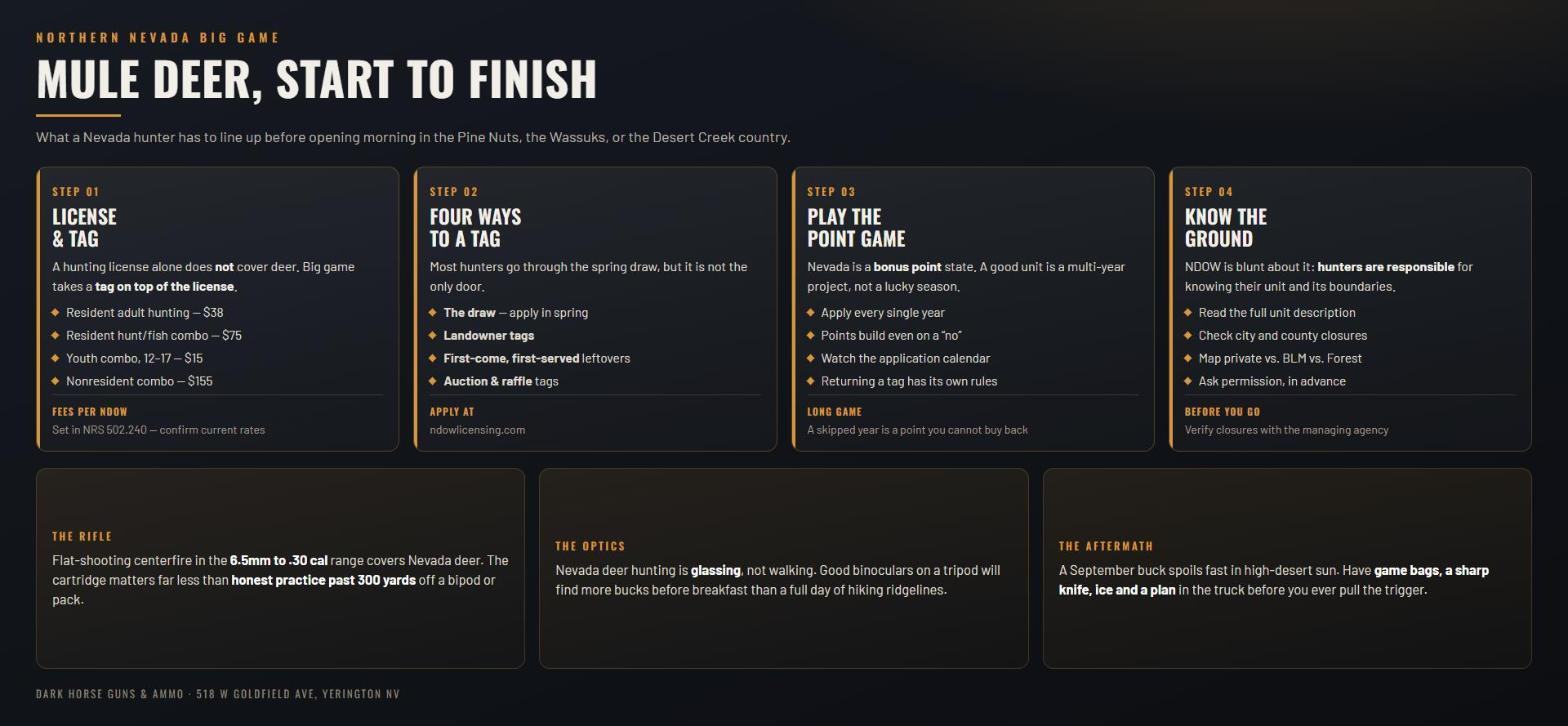
Everything starts with a Nevada hunting license. At the fees NDOW currently lists, a resident adult hunting license runs $38 and the resident adult combination hunting and fishing license runs $75. Youth combination licenses for ages 12 to 17 are $15, and a nonresident adult combination is $155. Apprentice licenses for hunters 12 and older are $15 and are sold at NDOW offices only.
Those numbers are set by the Legislature in NRS 502.240 and they do change, so confirm the current figures on NDOW's licenses, tags and permits page before you budget the season.
Then the tag, which is where people get tripped up
A Nevada hunting license on its own lets you hunt upland game and waterfowl during the open seasons. It does not cover deer. Big game animals require a tag in addition to the license, and there are four realistic ways to end up holding one.
- The draw. This is how most hunters get a deer tag. You apply in the spring through the state licensing system, and a computer decides. Watch the big game application calendar every year, because the window is not long.
- Landowner tags. Nevada issues a portion of tags to landowners, who may sell or transfer them. They are expensive, but they are a real option if you have the money and no points.
- First-come, first-served. Tags that go unclaimed after the draw get released. These move fast and they reward hunters who are watching the calendar.
- Auctions and raffles. Heritage, Dream, Partnership in Wildlife and Silver State tags are distributed through third-party organizations. Long odds on the raffles, deep pockets on the auctions, but the money goes back into wildlife.
Bonus points are the whole long game
Nevada runs a bonus point system, and understanding it is the difference between a hunter who draws every few years and one who complains about the draw for a decade.
Every year you apply and do not draw, you bank a point. Those points weight your odds in future draws. The math is simple and unforgiving: you cannot buy a point back. A year you skip is a year of progress you never get. Even in a season when you know you are not going to hunt, put in the application.
The same discipline applies to the small stuff. There are rules around returning a tag, transferring a tag, and remaining eligible, and every one of them is spelled out in NDOW's application material. Read it once carefully and you will not have to think about it again.
Know the unit before you worry about the rifle
NDOW is direct on this point: the responsibility for knowing your hunt area, its boundaries, and any closures inside it belongs to the hunter, not to the agency. Nobody is going to stop you at the cattle guard and explain the line.
Around Lyon County that means reading the unit description carefully, then layering on the ownership map. This is checkerboard country. Bureau of Land Management ground, Forest Service ground, state land, tribal land and private ranch can sit within a mile of each other with nothing but a fencepost to tell you. A mapping app with a current private-land layer is the cheapest insurance you will buy all season.
It is also worth a phone call. County, municipal, state and federal agencies all have the authority to close areas or impose restrictions, and NDOW specifically tells hunters to contact them directly rather than assume.
The rifle matters less than the practice
Nevada mule deer are not hard to kill. They are hard to get close to. Any flat-shooting centerfire from the 6.5mm class up through the .30 calibers will do the job cleanly, and arguing about which one is a hobby, not a strategy.
What actually separates hunters here is honest practice at distance, from field positions, in wind. Shooting a tight group off a bench at 100 yards tells you the rifle works. It tells you almost nothing about whether you can make a 320-yard shot off a pack, uphill, breathing hard, with a crosswind pushing through a saddle. Build that skill before October and then set a personal maximum range and actually respect it.
Bring more optic than you think you need, too. Nevada deer hunting is a glassing game. A good pair of binoculars on a tripod, worked slowly across a hillside at first light, will find more deer in an hour than a full day of walking ridgelines ever will.
If your hunt includes Mason Valley WMA, the rifle stays home
This one catches people, so it gets its own section. Mason Valley Wildlife Management Area — MVWA, the NDOW-managed ground on the Walker River just outside Yerington — has its own weapon rules for deer, and they are far narrower than general Nevada ground.
Under NDOW's rules for the area, deer on Mason Valley may be taken only with:
- A shotgun, no larger than 10 gauge and no smaller than 20 gauge, firing rifled slugs, shotgun rounds with sabots containing rifled slugs, or a single expanding projectile. The barrel may be smoothbore, partially rifled or fully rifled.
- A bow and arrow. And during the season set for the archery hunt for deer, bow and arrow is the only legal choice.
No centerfire rifle. Everything in the section above about a rifle you shoot well simply does not apply on that piece of ground.
There is a calendar restriction on top of it. During the waterfowl season, deer hunting on Mason Valley is limited to Saturdays, Sundays and Wednesdays, plus Nevada Day, November 11 for Veterans Day, Thanksgiving and Family Day. A Tuesday morning in late November is not a hunting day there.
If any part of your hunt overlaps the area, read NDOW's public land page before you pack and read the kiosk at the gate. We go through the area rules in more detail in our Mason Valley waterfowl post.
The part nobody plans for
An early-season buck in high-desert sun will spoil faster than most new hunters believe. Have the recovery plan built before you pull the trigger, not after.
- Game bags, two sharp knives and a means to sharpen them.
- Shade, airflow and something to hang the quarters from.
- A cooler and a real plan for ice, in the truck, already.
- Your processor's phone number and hours, saved before you leave town.
Wasting edible game meat is illegal in Nevada and, frankly, is the fastest way to lose the respect of every hunter you know. Treat the recovery as part of the hunt.
One more thing about the country
September and October in Northern Nevada are still fire season. Check for Bureau of Land Management and Forest Service fire restrictions before you drive out, keep a shovel and water in the truck, and be careful where you park a hot vehicle in tall cheatgrass. We covered this in more detail in our post on shooting on public land in Northern Nevada, and every word of it applies to deer camp.
Where to verify everything
Regulations, quotas, unit boundaries and fees change from year to year. Do not take a blog post as gospel, including this one. Go straight to the source:
- NDOW Your Public Land — wildlife management area rules, including Mason Valley
- NDOW licenses, tags and permits
- NDOW Plan Your Hunt
- NDOW rules and regulations
- NDOW mule deer species page
Come by before opening day
We are at 518 W Goldfield Ave in Yerington, open Tuesday through Saturday, 10 to 5. Come in and talk through your rifle setup, pick up ammunition, get glass mounted, or just tell us where you drew and let us point you at somebody who knows that country. We would rather spend twenty minutes with you in August than hear about a rough hunt in November.
Get in touchDark Horse Guns & Ammo LLC is a federally licensed dealer in Yerington, Nevada. This article is general information for hunters, not legal advice and not an official statement of Nevada hunting regulations. License fees, season dates, quotas, unit boundaries and application deadlines change. Always verify current requirements directly with the Nevada Department of Wildlife, the appropriate land management agency, or a qualified attorney before you hunt.